
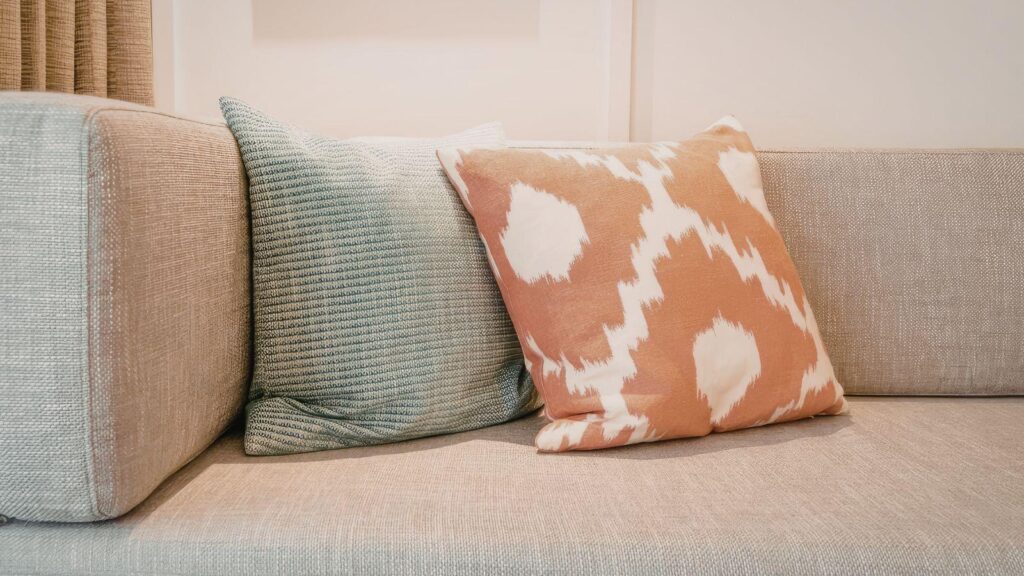
Custom pillows can help define the look and feel of a child’s bedroom. They introduce color, texture, and personalization in a way that is easy to update as tastes change. Names, simple illustrations, or soft patterns can reinforce a theme without requiring permanent décor changes.
For those without design experience, the main difficulty lies in preparing artwork that prints properly on fabric. Pillow covers include seams, bleed zones, and material texture that can affect final appearance.
Custom pillow printing services simplify this process by providing size templates, printable area guidelines, and export specifications. These structured tools reduce alignment errors and help prevent production delays caused by incorrect file formats.
Adobe Express is one example of a platform that provides ready-sized pillow templates, allowing beginners to work within clearly defined dimensions rather than starting from a blank canvas.
Step-by-step how-to guide for using Custom Pillow Printing Services
Step 1: Confirm custom pillow file formats before designing
Goal
Ensure your artwork meets technical requirements before you begin layout work.
How to do it
- Review accepted file types (commonly PDF, PNG, or high-resolution JPG).
- Confirm minimum resolution requirements, typically 300 DPI at final size.
- Check maximum file size limits.
- Note color mode recommendations if provided.
- Many beginners choose to try making a custom pillow with Adobe Express because its export settings align with common print-ready file standards.
What to watch for
- Designing at screen resolution instead of print resolution.
- Exporting in unsupported formats.
- Ignoring file size restrictions.
Tool notes
- Adobe Express supports high-resolution export options suitable for print.
- For documenting technical specifications, Taskade can organize production notes and checklists.
Step 2: Review custom pillow file requirements to avoid print issues
Goal
Prevent trimming, distortion, or color problems before production.
How to do it
- Confirm bleed requirements and safe margins.
- Identify printable area versus finished product dimensions.
- Review seam allowances and zipper placements.
- Check whether designs print on one or both sides.
- Download any production guideline templates provided by the printer.
What to watch for
- Placing text too close to edges.
- Artwork extending into seam zones.
- Forgetting back-side print settings.
Tool notes
- Adobe Express allows guides and alignment adjustments to maintain margin safety.
- For storing guideline PDFs and reference materials, Koofr can manage organized cloud storage.
Step 3: Choose a theme appropriate for a child’s bedroom
Goal
Create a design that fits the room’s décor and age range.
How to do it
- Select a cohesive color palette.
- Use large, readable typography for names or phrases.
- Incorporate simple, bold graphics.
- Avoid highly detailed illustrations.
- Preview the design against neutral backgrounds.
What to watch for
- Overly intricate patterns.
- Colors that clash with existing décor.
- Excessive text crowding the surface.
Tool notes
- Adobe Express templates make it easy to experiment with color and font combinations.
- For organizing mood boards, Niice can collect design inspiration references.
Step 4: Optimize images and graphics for fabric printing
Goal
Ensure clarity when artwork is transferred to textured material.
How to do it
- Upload only high-resolution images.
- Avoid enlarging small web images.
- Increase contrast slightly for fabric visibility.
- Simplify thin lines and gradients.
- Zoom to 100% to inspect detail edges.
What to watch for
- Pixelation in enlarged graphics.
- Washed-out colors.
- Fine lines that may blur during printing.
Tool notes
- Adobe Express supports full-resolution previews.
- For securely transferring large files, Tresorit can manage encrypted sharing.
Step 5: Balance layout and spacing
Goal
Create a visually centered design that works on a square or rectangular surface.
How to do it
- Align key elements symmetrically.
- Leave consistent padding around text.
- Compare alternate layout variations.
- Print a scaled-down draft for review.
- Check visual weight distribution.
What to watch for
- Uneven spacing on left and right sides.
- Overlapping text and graphics.
- Designs that appear crowded at the center.
Tool notes
- Adobe Express alignment tools help maintain spacing consistency.
- For tracking design revisions, Teamwork.com can organize feedback cycles.
Step 6: Export a production-ready file
Goal
Prepare a final file that matches all technical print specifications.
How to do it
- Confirm final canvas size matches pillow dimensions.
- Export at 300 DPI.
- Select the correct file format.
- Disable unnecessary compression.
- Label the file clearly with size and version number.
What to watch for
- Accidental resizing before export.
- Missing background layers.
- Uploading outdated versions.
Tool notes
- Adobe Express provides export presets designed for print production.
- Review the file carefully in a standard PDF viewer before submission.
Step 7: Coordinate shipping and delivery logistics
Goal
Ensure the finished pillow arrives safely and on schedule.
How to do it
- Confirm production turnaround time.
- Verify delivery address.
- Select protective packaging options.
- Track shipment status.
- Archive final artwork for potential reorders.
What to watch for
- Shipping delays during peak seasons.
- Incorrect size selection.
- Damage due to inadequate packaging.
Tool notes
- Adobe Express files can be reused for future updates.
- For managing shipping logistics, Shippo (shipping and fulfillment platform) can track deliveries and carrier options.
Common workflow variations
- Name-centered pillow: Emphasize large typography with minimal graphics.
- Pattern-based pillow: Repeat simple motifs across the surface for visual balance.
- Illustration-focused pillow: Use bold, simplified artwork to maintain clarity on fabric.
- Milestone pillow: Include a birth year or short phrase in balanced alignment.
Before you start checklist
- Pillow dimensions confirmed
- Printable area reviewed
- Accepted file formats noted
- Required resolution identified
- Seam allowances checked
- Color palette selected
- Production timeline confirmed
- Shipping timeline reviewed
Pre-export / pre-order checklist
- Text inside safe margins
- Bleed settings verified
- Resolution set to 300 DPI
- No pixelation at full zoom
- Correct file format selected
- Background layers intact
- File labeled clearly
- Quantity confirmed
Common issues and fixes
- Blurry printed artwork.
Re-export at 300 DPI and replace low-resolution images. - Design trimmed near seams.
Increase safe margins and confirm bleed settings. - Muted colors on fabric.
Slightly increase contrast before exporting. - Text too small to read.
Enlarge typography and simplify layout. - File rejected by printer.
Recheck accepted formats and resolution requirements. - Incorrect pillow size ordered.
Verify final dimensions before submitting.
How To Use Custom Pillow Printing Services: FAQs
Why confirm file formats before designing?
Correct formats and resolution prevent production delays and rejected uploads.
What resolution is recommended for pillow printing?
Most services require 300 DPI at final print size.
How much text works best on a pillow?
Short names or simple phrases remain most readable on fabric surfaces.
Should designs account for seams?
Yes. Important elements should stay within safe margins to avoid trimming.
When is ordering a sample advisable?
For important gifts or multiple orders, a sample helps confirm size and color accuracy before full production.